The Oslo Walking Tour Route, Stop by Stop

Jernbanetorget and the bronze tiger
The square outside Oslo Central Station, and the meeting point for two of the six walks. The tiger is the one everybody photographs, and it is there because Oslo’s nickname is Tigerstaden, the Tiger City, a name probably taken from an 1870 poem by Bjørnstjerne Bjørnson about what was then Christiania. I am not going to tell you who sculpted the animal or when it was unveiled, because I have seen three confident answers to that and cannot verify any of them. What matters practically is that it is impossible to miss and everybody meets there.
The Opera House
The first stop on nearly every itinerary and the one that changes how people think about the city. You walk up the outside of it. Guides tend to stop at the bottom of the slope rather than the top, because the group spreads out once it is on the roof and getting forty people back is a ten-minute job.
Christiania Torv and Kvadraturen
Kvadraturen is the grid-plan old town, and Christiania Torv is the square at the heart of it. This is the oldest-feeling part of the route and the one where a guide earns their keep, because there is very little signage and the story is not obvious from the buildings. It is also where the cobbles start, which matters if you are in thin soles — see footwear rather than fashion.
Akershus Fortress
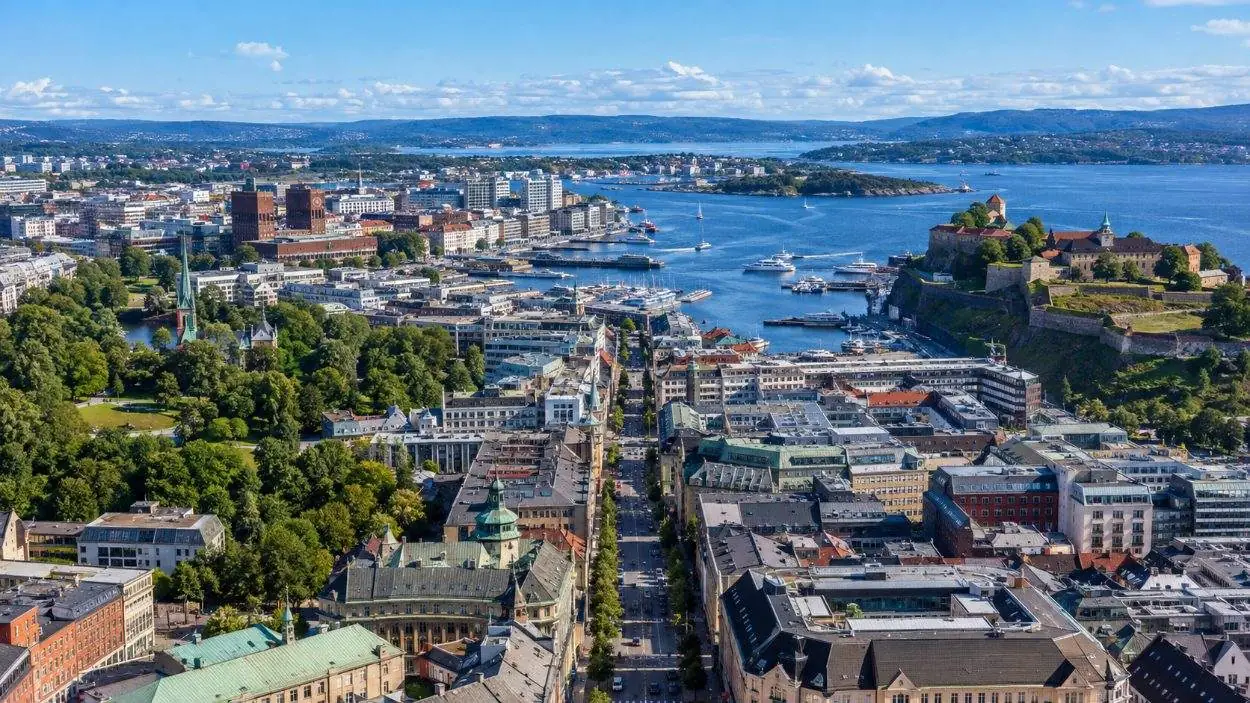
Every walking tour passes the fortress and none of them goes inside the castle. That is worth stating clearly, because people book expecting it. The grounds are free to walk through and open daily, which is exactly why every itinerary includes them; the castle interior is a separate paid ticket and a separate visit, on your own time. The walks give you the ramparts, the approach and the view back over the water.
The fortress grounds are the one part of this route worth returning to alone in the evening. They are free, they are open, and without a group you can follow the walls instead of the commentary. Do the guided version first so you know what you are looking at.
Oslo City Hall and Fridtjof Nansens plass
The City Hall is the pivot of the route, and the square in front of it is the meeting point for the Myths & Legends evening walk, which takes ages thirteen and over and is not wheelchair accessible. It is also the windiest place on the whole line. The gap between the building and the water funnels everything coming off the fjord straight across the square, and in February a group standing there stops listening within about four minutes. Good guides move you.
Aker Brygge
The waterfront, and the point where the route turns back inland. Some walks include it, some skip it depending on time. It is the least historical stop and the one most people photograph anyway.
Karl Johans gate, the Parliament and the University Aula
The main street, named in 1852 after the recently deceased king Charles III John, who also reigned as Charles XIV John of Sweden. Its western section, built in the 1840s, is the part that runs to the Royal Palace. The Parliament building sits partway along, completed in 1866 at the junction where two formerly separate streets were joined into one — which is the kind of detail you only get from somebody standing next to you pointing at it. The University Aula is further up, and it is the meeting point for one of the six walks when booked in English. More on the street itself on Karl Johans gate.
The Royal Palace
The end of the line for almost every walk. An equestrian statue of Charles III John by the sculptor Brynjulf Bergslien was put up in front of the palace in 1875, and it is where guides finish, partly because it is a good ending and partly because it is somewhere a group can stand without blocking anything.
Which of the six covers what
- Central Oslo walk — the tiger, the Opera House, Christiania Torv, Akershus, the City Hall, Oslo Cathedral, Karl Johans gate, Aker Brygge, the Parliament, the Royal Palace. Two hours, English. The fullest version of the line.
- City Center walk — twelve named stops in ninety minutes, from the Opera House via the Oslo Stock Exchange, Christiania Torv, Akershus, the Nobel Peace Center, Aker Brygge, the City Hall, the National Theatre, the University Aula, the Royal Palace and Karl Johans gate, finishing at the Parliament.
- Independent guide’s walk — the Opera House, Langkaia, Kvadraturen, Akershus, Karl Johans gate, the Parliament, the Royal Palace, the City Hall, Aker Brygge, and optionally Vigeland Sculpture Park by tram. Maximum ten guests.
- City Highlights walk, guided in German — the Nobel Peace Center, Akershus, Christiania Torv, Kvadraturen, the Opera House, Karl Johans gate, Oslo Cathedral, the Parliament, the National Theatre, the University Aula, the Royal Palace. The same line, in German.
- Myths & Legends evening walk — the City Hall, Norwegian folklore and Viking belief, Christiania Torv, Akershus Fortress, and Bankplassen with its history of robberies. Ages thirteen and over, and not wheelchair accessible. The only genuinely different material of the six.
Which is why the comparison page leads with the fact that the route is not the variable. If you would rather walk it yourself, the self-guided version is honest about what a guide adds and what they do not.
The fullest version of this route
Two hours in English, starting from the bronze tiger at Jernbanetorget and finishing at the Royal Palace, with tips listed under what is included. What not to miss covers the things just off the line.
Frequently asked questions
What do you see on an Oslo walking tour?
The same central kilometre on almost every walk: Jernbanetorget and the bronze tiger, the Opera House, Christiania Torv and Kvadraturen, Akershus Fortress, Oslo City Hall, Aker Brygge, Karl Johans gate, the Parliament, the University Aula and the Royal Palace. Which walk covers which stops.
Do walking tours go inside Akershus Fortress castle?
No. The fortress grounds are free to walk through and open daily, which is why every itinerary includes them, but going inside the castle is a separate paid ticket and a separate visit. No walking tour includes it. Plan it as its own hour — one day in Oslo shows where it fits.
How long is the Oslo walking tour route?
Roughly a kilometre end to end, from the station up to the Royal Palace. Walks take ninety minutes to two hours to cover it because of the stopping, not the distance. How long each of the six takes.
Is the route flat?
Largely, yes. The centre of Oslo is flat between the station and the palace, with a gentle rise up Karl Johans gate at the end and cobbles through Kvadraturen. The slope up the outside of the Opera House is optional on most walks, and two of the six state mobility limits outright.