Karl Johans gate, Oslo’s Main Street
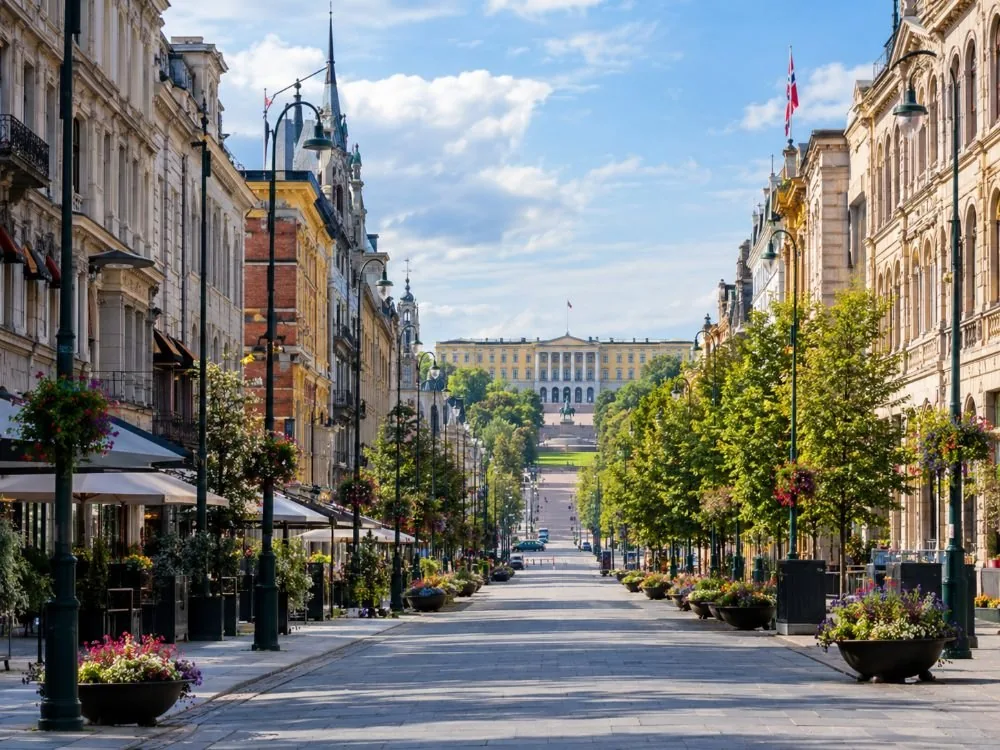
The joined-streets detail is the one worth carrying, because it explains the shape of the walk. The Parliament does not sit at a grand ceremonial address by design; it sits at a junction, and the street you are standing on was assembled around it. That is the kind of thing a guide can point at and a map cannot tell you, and it is most of the argument for taking a walking tour in a city this legible. The full route, stop by stop.
Walk the street twice, once with the group and once alone at either end of the day. Guided, you get the Parliament, the University Aula and the palace explained; alone, you notice that the street rises the whole way and that almost every tour finishes at the top of it, which is why you will not be near your hotel at the end.
The walk that ends here
Two hours in English from the bronze tiger at Jernbanetorget, covering Karl Johans gate, the Parliament and the Royal Palace, with tips listed as included. What else is on the line.
Frequently asked questions
What is the most famous street in Oslo?
Karl Johans gate, which runs up to the Royal Palace and carries the Parliament, the National Theatre and the University Aula along its length. Nearly every guided walk finishes on it. The route in order.
Who is Karl Johans gate named after?
King Charles III John, who also reigned as Charles XIV John of Sweden. The street was named in 1852, after his death, and an equestrian statue of him by Brynjulf Bergslien was erected in front of the Royal Palace in 1875. What else to see on the route.
Is the Norwegian Parliament on Karl Johans gate?
Yes. It was completed in 1866, at the junction where two formerly separate streets were joined into one to form the street as it now runs. Most walking tours pass it. Which walks include it.